

Back to Blog

Blog / Classroom Discussion

When a Chart Does Not Answer the Question

Chart-Ed TeamJune 3, 20265 min read0 comments
When a Chart Does Not Answer the Question hero

When a Chart Does Not Answer the Question

Picture a science class. A student points to a bar chart and asks, “Does this prove that fertilizer makes plants grow taller?” The chart shows plant heights for two groups, but there’s no information about fertilizer. Your first instinct might be to launch into an explanation.

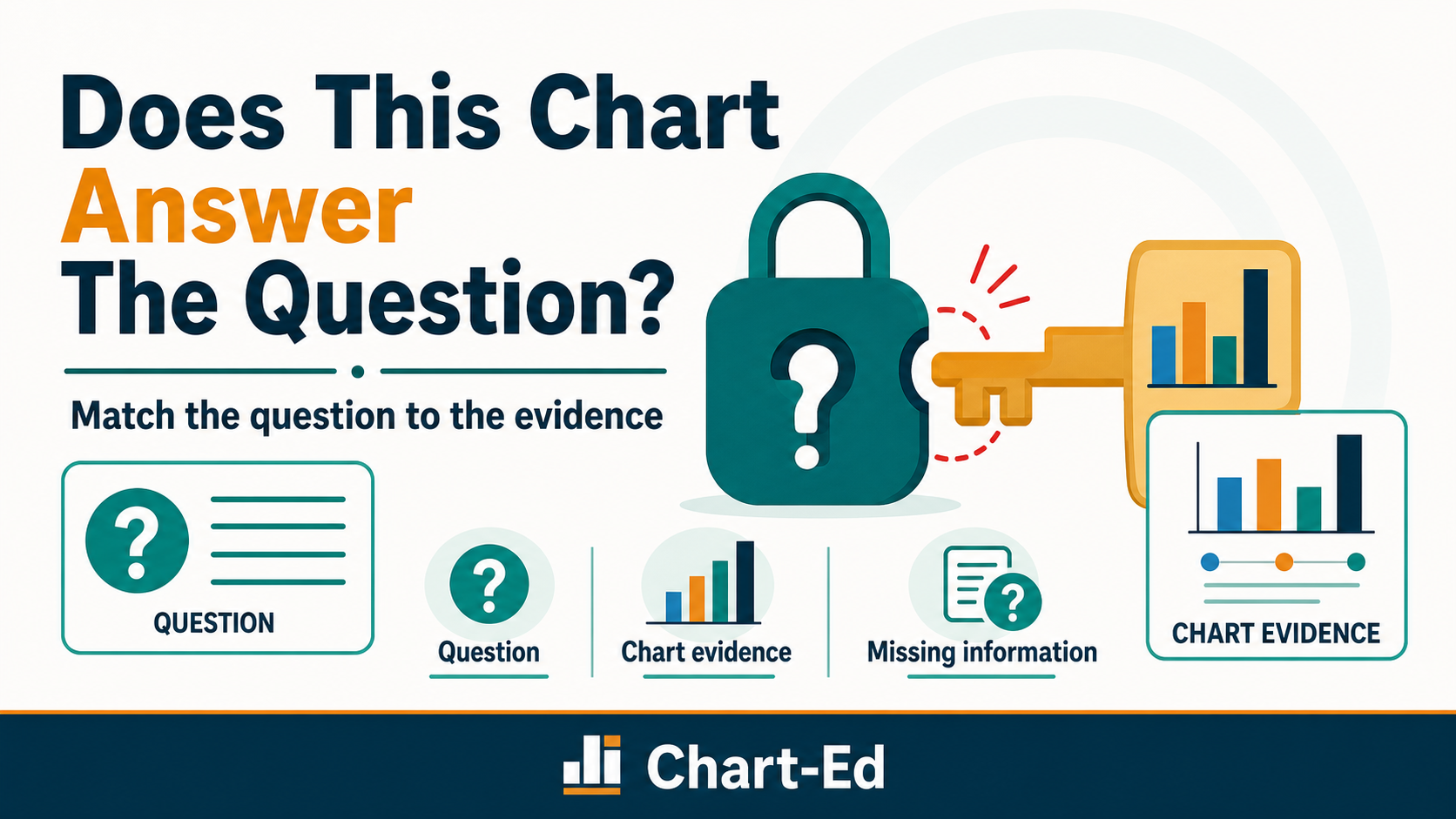
But what if the most powerful move is to step back and say, “Let’s look at what the chart actually tells us – and what it doesn’t”? Helping students notice when a question goes beyond the evidence shown is a vital data-literacy skill. And normalizing “we cannot tell from this chart” as a strength – not a failure – changes the culture of your classroom.

Here’s how to make it a routine part of your students’ thinking.

Why “We Can’t Tell” Is a Data Superpower

Teachers often feel pressure to provide definite answers. But when we rush to fill in the gaps for students, we rob them of a chance to practice evaluating evidence on their own. Explicitly teaching students to check whether a chart’s data match the question being asked builds deeper, more transferable analytical habits.

When students learn to pause and ask, “Does this chart actually contain the evidence I need?” , they move from passive graph readers to active critical thinkers. They begin to see that a chart is a limited snapshot – it shows certain variables, over a specific time, under particular conditions.

Celebrating the observation “I can’t tell from this chart” reinforces that careful thinking isn’t about always having the right answer; it’s about knowing when the available information is insufficient.

A Simple Classroom Routine: Question vs. Evidence Check

You don’t need a special curriculum to weave this into your lessons. A lightweight, repeatable routine works across subjects and grade levels:

  1. Pair a chart with a specific question. It could be student-generated or teacher-provided.
  2. Examine the chart. Identify what variables are shown, check axes, labels, titles, and any notes.
  3. Compare. Does the chart include the exact variables mentioned in the question? Is the timescale, population, or condition a match?
  4. Decide. If the answer is yes, the chart might help answer the question. If not, it’s time to say: “We cannot tell from this chart.”

Model this out loud. When a student asks a question that the chart can’t answer, avoid the instinct to explain it away. Instead, ask guiding questions: “What would the chart need to show for us to answer that?” or “What’s missing from the chart that we’d need to know?” This positions uncertainty as a productive step in the investigation, not a dead end.

Try This Tomorrow: The Mismatch Warm‑Up

Here’s a concrete example you can use right away. Show a simple line graph of average monthly temperature over the course of a year for one city. Then ask your students, “How does humidity affect temperature in this city?” Let them think. Some may try to infer a relationship based on prior knowledge. But a close look reveals that humidity is nowhere on the chart. The graph shows only time and temperature. So the honest, evidence-based answer is: “We cannot tell from this chart, because humidity isn’t included.” Push the thinking further with sentence starters that make the logic visible:

  • “This chart shows ______, but it doesn’t show ______, so we cannot tell ______.”
  • “To answer that question, we would need a chart that also includes ______.”

These scaffolds help students, especially those who are still building academic language, articulate the mismatch without embarrassment. And the more you use them, the more natural it becomes for students to apply the same check independently.

Keeping It Positive – and Repeatable

Normalize “we can’t tell” as a sign of careful thinking, not a mistake. Even expert data analysts frequently conclude that a given dataset doesn’t contain the evidence they need. Emphasizing this destigmatizes uncertainty and frames it as the first step toward finding better evidence. Once students identify what’s missing, that insight can power the next phase of inquiry. They might:

  • Redesign the study or data collection to capture the missing variable.
  • Search for another graph or dataset that does include the needed information.
  • Propose a follow-up question the current chart can answer, deepening their engagement with the data that is present.

This mirrors real scientific and civic practice: evaluating the limits of evidence is fundamental to making well-supported claims. Far from shutting down curiosity, it channels it toward more precise questions and a healthier skepticism toward overgeneralizations.

Practical Takeaway

This week, as you plan your lesson, pick one chart you intend to show. Before class, write down two questions: one the chart can answer, and one it cannot. When you display the chart, share both questions with your students. Ask them to discuss in pairs: which question fits the evidence, and why? Listen to their reasoning. You’ll likely hear versions of “we can’t tell” – and that’s exactly the point. Celebrate it.

Where to Find Classroom‑Ready Charts

Chart-Ed’s Chart Bank offers a growing collection of classroom-safe charts that are perfect for “question vs. evidence” exercises. You can sort by topic, graphic type, and grade range, making it easy to find a chart that suits your next lesson. Pair any chart with Data Forensics activities, which provide structured prompts and routines that guide students in investigating what charts can – and can’t – tell us. Together, they turn evidence evaluation into a consistent classroom practice.

Let’s Hear Your “We Can’t Tell” Moments

Try the warm‑up or the question‑pairing routine with your students this week. Then share how it went: what surprised you, how your students reacted, and any clever observations they made. Tag @ChartEd on your favorite social platform, or drop us a note. We’d love to amplify your story and help other teachers give their students the superpower of a well‑placed “we can’t tell from this chart.”

Join the conversation

What would this look like in your classroom?

Blog posts are meant to start practical teacher conversation. Add a classroom move, a question, or a useful disagreement about "When a Chart Does Not Answer the Question."

Current discussion

Loading comments...