

Teacher Pain
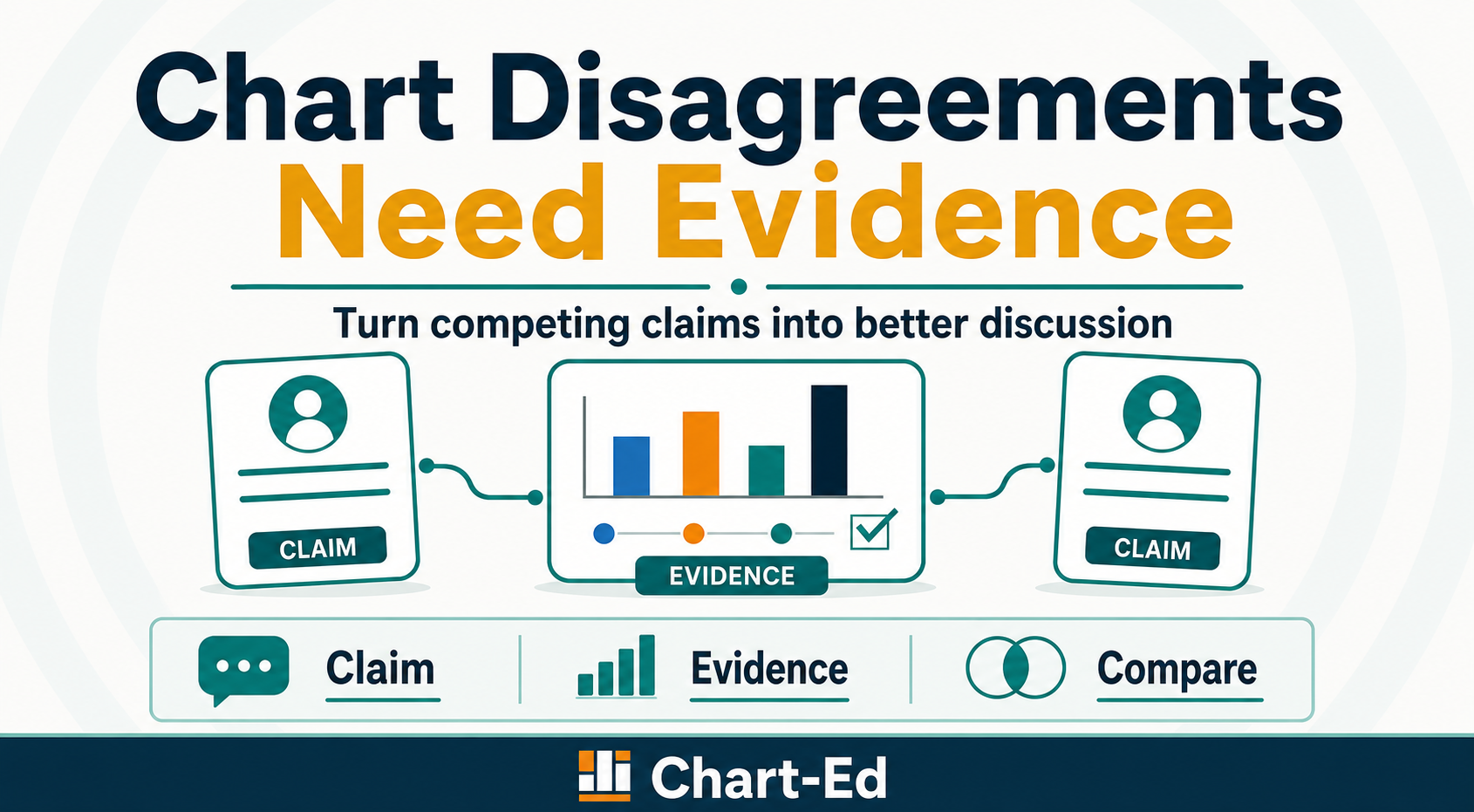
Students disagree about a chart, but the discussion becomes a contest of opinions instead of a careful comparison of evidence.
One student says:
The chart shows the program worked.
Another says:
No, it shows the program did not work.
The disagreement may be useful. The problem is that students often do not know how to make the disagreement accountable to the chart.
What Is Really Happening
Disagreement is not automatically a classroom management problem.
In chart work, disagreement often reveals that students are noticing different features, making different assumptions, or using different standards of evidence.
The reasoning problem is this:
Multiple claims are competing before the evidence has been organized.
Chart-Ed treats this as a discussion-calibration problem. The goal is not to silence disagreement. The goal is to make each claim show its evidence.
Classroom Move
Use a five-step discussion protocol:
Pause
State the claim
Point to evidence
Compare interpretations
Synthesize
This turns disagreement into a reasoning routine.
Step 1: Pause
Name the moment:
We are seeing this chart in more than one way. Let's slow down and examine the evidence.
This signals that the disagreement is worth studying.
Step 2: State The Claim
Ask each student to turn their interpretation into a clear claim:
What conclusion are you making from the chart?
Write the claim down if possible. Once a claim is visible, the class can examine it without making the discussion personal.
Step 3: Point To Evidence
Ask:
Where do you see evidence for that in the chart?
This is the center of the routine. Students should point to bars, lines, labels, axes, categories, trends, scales, or annotations.
Step 4: Compare Interpretations
Ask:
Could another conclusion also fit what the chart shows?
This helps students see that evidence can sometimes support more than one reasonable interpretation.
It also helps them notice when a claim depends on an assumption that is not shown in the chart.
Step 5: Synthesize
End by separating supported conclusions from open questions:
What can we say with evidence?
What remains uncertain?
What would we need to know next?
The class does not always need one winner. Sometimes the strongest learning is recognizing what the chart can support and what it cannot settle.
How To Use The Free Resource
Use the Evidence-Based Chart Discussion Protocol when a chart sparks debate, confusion, or competing answers.
The protocol gives students a shared language for disagreement:
What is the claim?
What is the evidence?
What else might fit?
What remains uncertain?
Common Mistake To Watch For
Do not rush too quickly to the correct answer.
If the teacher resolves the disagreement immediately, students may learn that chart interpretation is about guessing what the teacher wants.
Instead, hold the discussion long enough for students to see how evidence does the work.
Free Resource
Download the Evidence-Based Chart Discussion Protocol
Product Bridge
If you want students to practice evidence-based discussion with more structured chart scenarios, use Chart-Ed Data Forensics.