

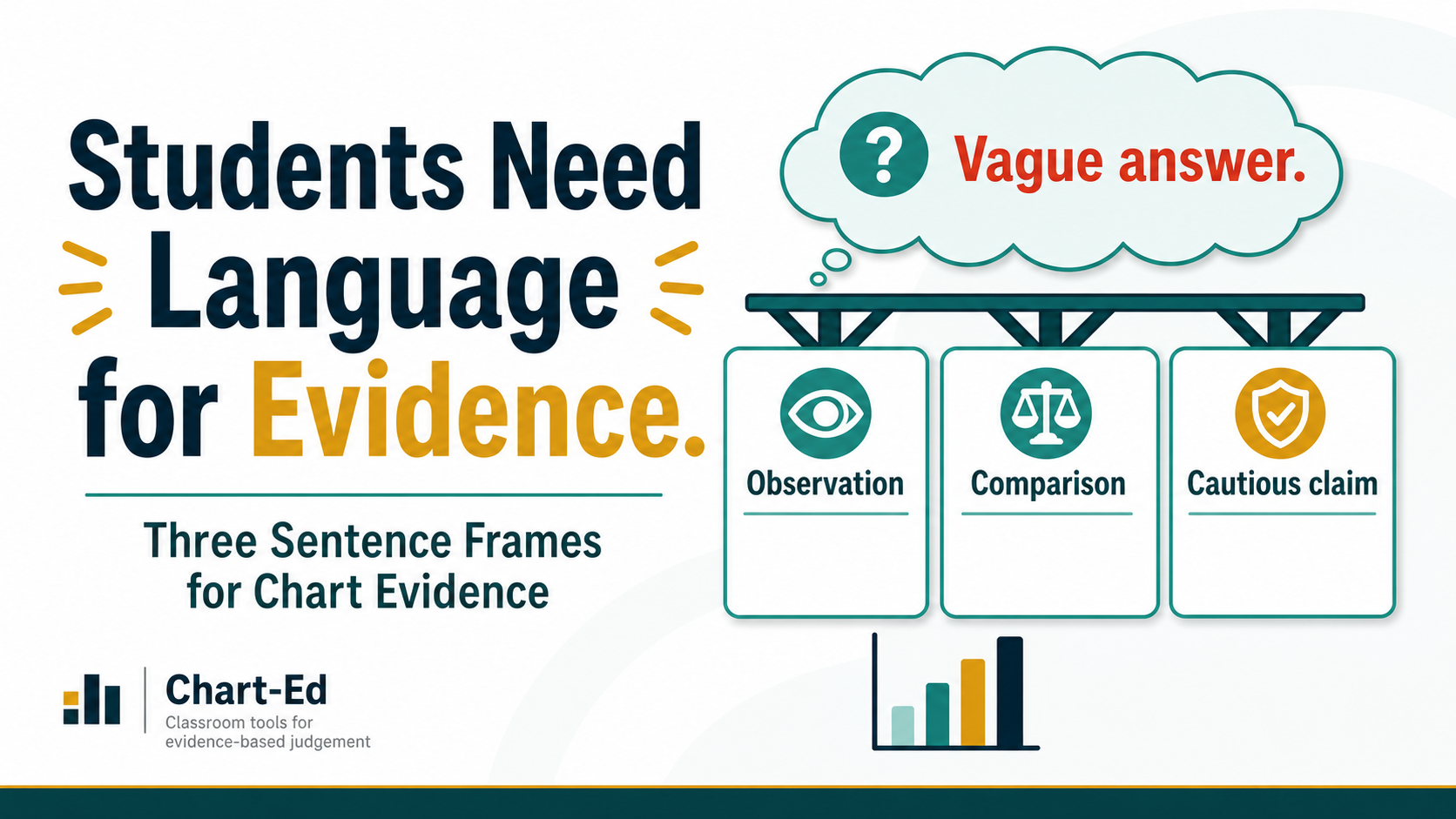
Students do not always need a longer explanation.
Sometimes they need a better starting sentence.
When a teacher asks, "What does the chart show?", students may answer with a shrug, a guess, or a sentence so broad that it could fit almost any graph. That does not always mean they are not thinking. Often, students need language before they can show the reasoning they are beginning to do.
A sentence frame gives student thinking a temporary structure. It lowers the blank-page pressure while still requiring students to stay close to the evidence.
The Classroom Problem
Students often move from:
chart
      ↓
answer
without making the middle step visible:
chart
      ↓
evidence
      ↓
reasoning
      ↓
claim
Sentence frames help reveal that middle step.
They do not replace reasoning. They make reasoning easier to hear, discuss, revise, and teach.
Frame 1: This Chart Shows
Use this when students need to begin with a neutral observation.
This chart shows ____ over/for ____.
Example:
This chart shows the number of library visits for each grade level.
This frame keeps students from rushing into explanation before they have named what is visible. It is especially useful when students are encountering a new chart type, working with unfamiliar content, or learning to distinguish observation from interpretation.
Frame 2: Compared To
Use this when students need to describe a relationship.
Compared to ____, the data for ____ is ____.
Example:
Compared to Monday, the number of students choosing the school lunch was higher on Friday.
This frame pushes students beyond naming a single bar, point, or category. They have to identify a comparison and describe the direction or size of the difference.
Follow-up question:
Where do you see that in the chart?
Frame 3: The Evidence Suggests
Use this when students are ready to make a cautious claim.
The evidence suggests ____ because ____.
Example:
The evidence suggests reading was a popular after-school choice because it had more students than art, music, or other activities.
The word suggests matters.
It reminds students that a chart can support a claim without proving every possible explanation. This small language move helps students practice evidence-based judgment without overclaiming.
How to Use the Frames Tomorrow
Choose one chart you already planned to use.
Model one frame aloud:
This chart shows...
Then ask students to try the same frame with a partner.
You do not need all three frames at once. Start with the frame that matches the kind of thinking you want:
- Use
This chart showsfor observation. - Use
Compared tofor comparison. - Use
The evidence suggestsfor cautious interpretation.
After students write, ask one follow-up question:
What in the chart supports that sentence?
That question turns the frame from a writing scaffold into an evidence habit.
Why This Works
Sentence frames give students language for the kinds of reasoning teachers want to hear:
- observation
- comparison
- cautious interpretation
- evidence support
They are not meant to make student thinking mechanical. They are meant to give students enough structure to say something precise.
Over time, the goal is for students to outgrow the frame while keeping the habit:
make a claim
locate the evidence
say only what the evidence supports
Free Resource
Download Three Sentence Frames for Chart Evidence
Use it for warm-ups, partner talk, written responses, exit tickets, or chart-based discussion.
Product Bridge
If you want structured practice helping students move from chart observations to evidence-based claims, connect this routine with Chart-Ed's Data Forensics, Data Ascent, and teacher implementation resources.