

Many teachers have experienced a frustrating classroom moment.
A student gives the correct answer.
You ask:
How do you know?
And the explanation falls apart.
Sometimes the student shrugs. Sometimes they repeat the answer. Sometimes they point vaguely to the chart, graph, or text without identifying evidence.
The answer may be correct.
The reasoning remains invisible.
Correct answers matter. They simply do not always reveal how a student arrived at the answer.
This raises an important question:
Have students truly learned if they cannot explain why their answer is justified?
The Difference Between Answers And Evidence
Many classroom tasks reward arriving at an answer.
Far fewer require students to explain how they arrived there.
As a result, students often become skilled at producing responses without developing the habit of supporting those responses with evidence.
This is particularly visible when students work with charts and graphs.
A student may identify the highest value. A student may identify a trend. A student may even select the correct multiple-choice answer.
Yet when asked, "What evidence supports your conclusion?" the response is often incomplete.
For example:
Teacher: Which month had the highest sales?
Student: March.
Teacher: What evidence supports that?
Student: March has the highest bar on the graph.
That brief exchange matters because the student has started to move from answer to evidence.
But the explanation is still thin.
"March has the highest bar on the graph" is a reasonable start, but it mostly restates the answer in visual terms.
A stronger response would name the actual value from the graph:
March had $4,200 in sales.
An even stronger response would compare that value to another month:
March had $4,200 in sales, which was higher than February's $3,100.
That difference matters.
Saying a bar is "the highest" describes what the student sees.
Naming the value and comparing it to another value turns the observation into evidence.
The issue is not that students lack answers.
The issue is that students have not learned to connect conclusions to evidence.
Why This Matters
In many classrooms, the correct answer becomes the endpoint.
In reality, the answer is only part of the process.
The more important question is:
Is the conclusion justified by the available evidence?
Students who cannot answer this question face challenges in science, social studies, mathematics, informational reading, assessment environments, and real-world decision making.
They may arrive at correct answers by intuition, guessing, partial understanding, or pattern recognition.
Without evidence, however, neither the student nor the teacher can determine whether the reasoning is sound.
What We Often See
Students commonly:
- state conclusions without citing evidence
- select answers that feel right
- ignore contradictory information
- overgeneralize from a single data point
- confuse observation with interpretation
These are not merely graph literacy problems.
They are reasoning problems.
Charts simply make them visible.
A Simple Shift
One of the most powerful instructional moves a teacher can make is asking:
What evidence supports that claim?
Not:
What is the answer?
But:
What evidence supports the answer?
This small shift changes the classroom conversation.
Students begin looking for support rather than guesses. They begin connecting conclusions to evidence. They begin making their reasoning visible.
Building The Habit
Students rarely develop evidence-based reasoning by accident.
The habit must be practiced repeatedly.
Simple structures can help:
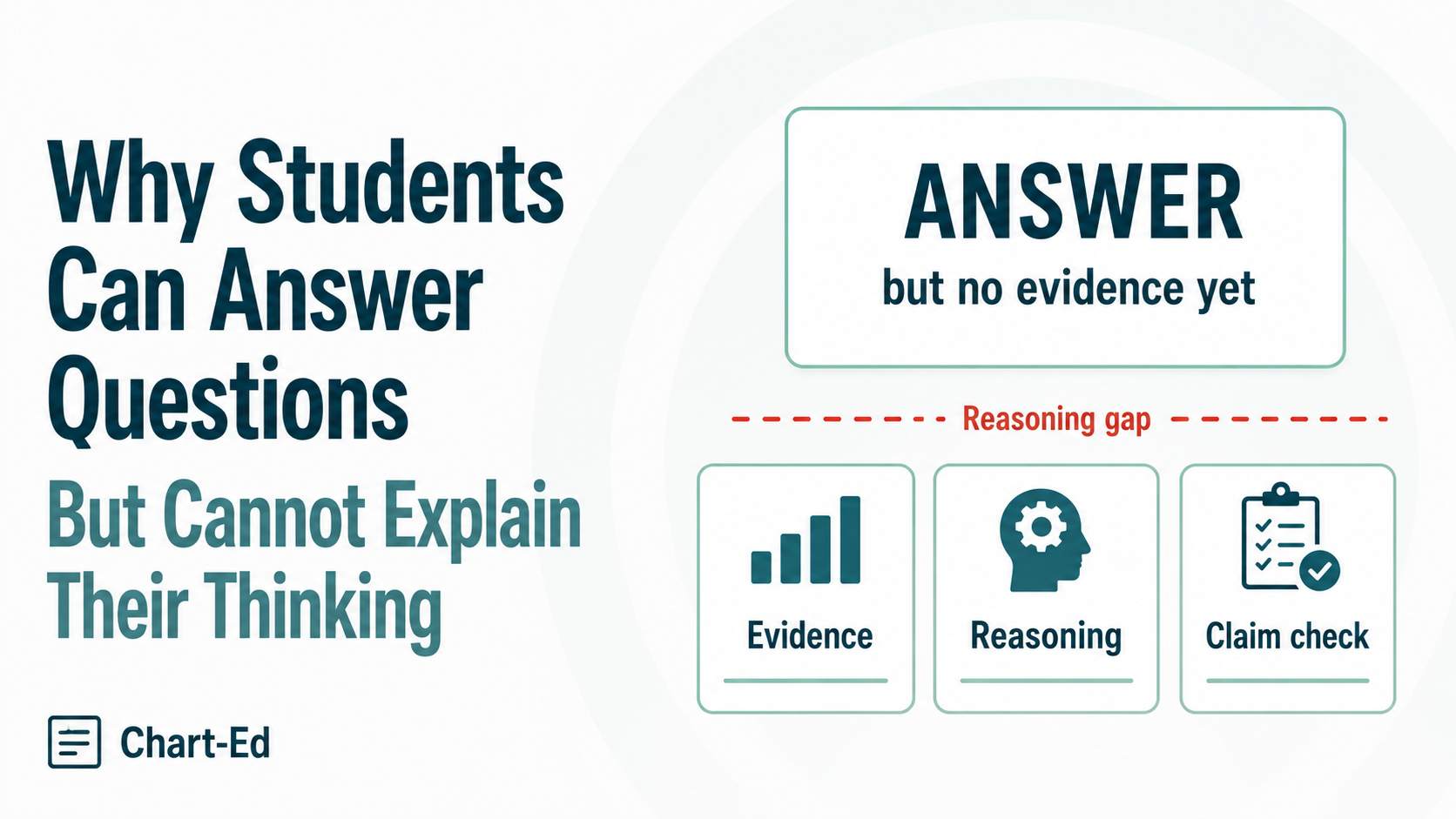
Claim
What conclusion am I making?

Evidence
What information supports that conclusion?

Reasoning
How does the evidence support the conclusion?
These routines slow thinking down in productive ways.
They encourage students to justify rather than merely respond.
The goal is not simply to collect evidence.
The goal is to reach conclusions that match what the evidence actually supports.
Students who develop this habit become better judges of information, arguments, charts, and claims.
The Bigger Goal
The goal is not simply to improve chart interpretation.
The goal is to help students develop the habit of supporting conclusions with evidence.
When students learn to connect claims and evidence consistently, they become stronger readers, stronger thinkers, stronger problem solvers, and stronger communicators.
Most importantly, they become better judges of what the evidence actually supports.
And that habit may matter long after they leave the classroom.
Free Resource
Looking for a simple classroom tool to help students connect claims and evidence?
Download the free Claim-Evidence Response Card
Product Bridge
Looking for structured practice that develops evidence-based reasoning across multiple chart types and complexity levels?
Bibliography
- Kuhn, D. (1991). The Skills of Argument. Cambridge University Press. https://doi.org/10.1017/CBO9780511571350
- McNeill, K. L., Lizotte, D. J., Krajcik, J., and Marx, R. W. (2006). "Supporting Students' Construction of Scientific Explanations by Fading Scaffolds in Instructional Materials." Journal of the Learning Sciences, 15(2), 153-191. https://doi.org/10.1207/s15327809jls1502_1
- McNeill, K. L., and Krajcik, J. (2008). "Scientific explanations: Characterizing and evaluating the effects of teachers' instructional practices on student learning." Journal of Research in Science Teaching, 45(1), 53-78. https://doi.org/10.1002/tea.20201
- Osborne, J. (2010). "Arguing to Learn in Science: The Role of Collaborative, Critical Discourse." Science, 328(5977), 463-466. https://doi.org/10.1126/science.1183944
- Sandoval, W. A., and Millwood, K. A. (2005). "The Quality of Students' Use of Evidence in Written Scientific Explanations." Cognition and Instruction, 23(1), 23-55. https://doi.org/10.1207/s1532690xci2301_2