

Teacher Pain
Students often use a related chart as if it answers the question being asked.
A student might ask:
Does this prove fertilizer makes plants grow taller?
But the chart may only show plant height. It may not show fertilizer use, soil type, sunlight, water, time, or group conditions.
The classroom problem is not that students cannot read the chart. The problem is that they do not always check whether the chart contains the evidence needed for the question.
What Is Really Happening
Students are treating relevance as evidence.
The chart seems connected to the question, so they use it as if it can answer the question.
The reasoning problem is this:
The question requires evidence the chart does not contain.
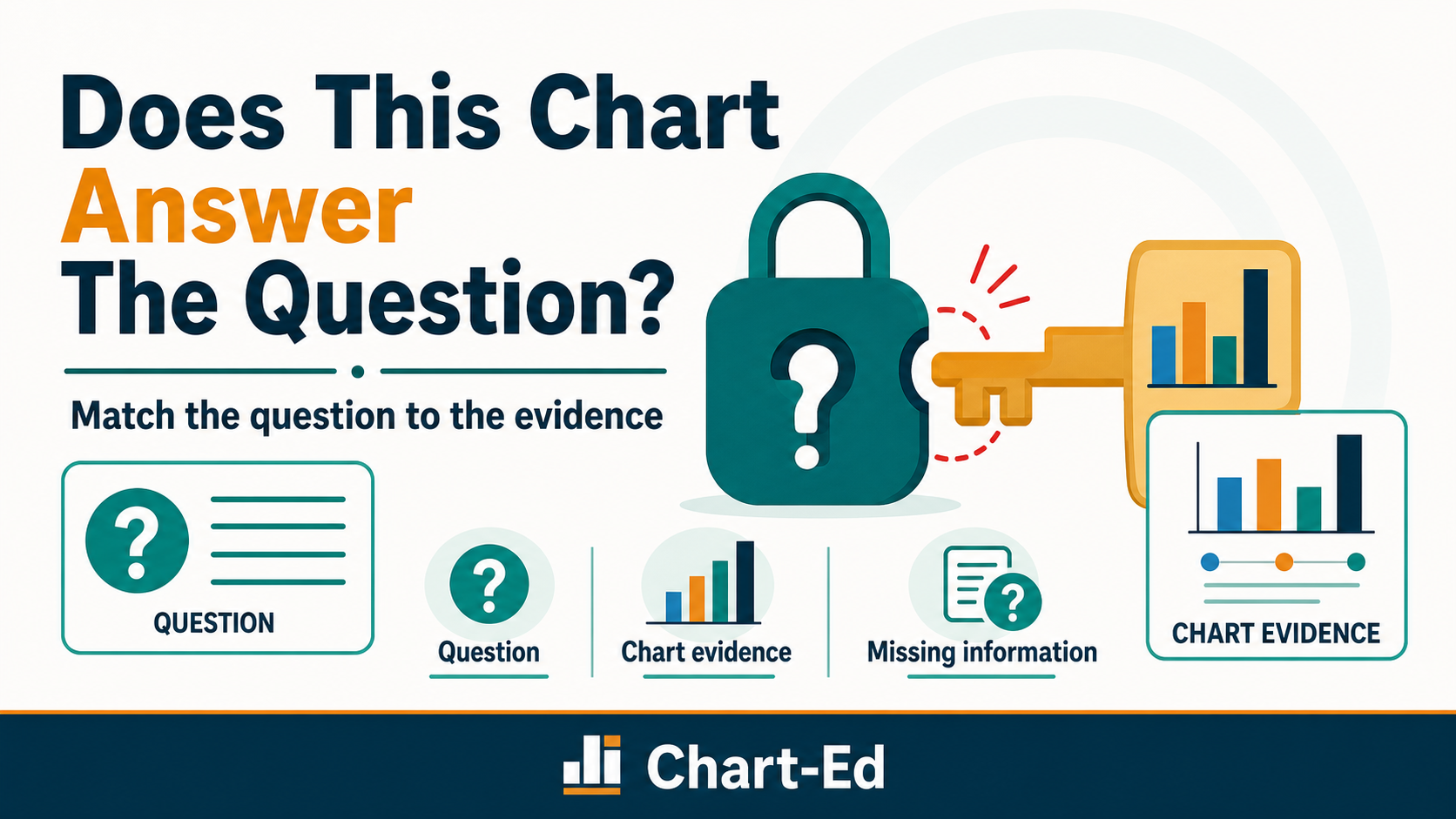
Chart-Ed treats this as an evidence-question mismatch. A chart can be useful, interesting, and accurate while still failing to answer the question in front of the class.
Classroom Move
Normalize this sentence:
We cannot tell from this chart.
That is not a failure. It is a sign that students are thinking carefully about evidence.
Then ask:
What does the chart show?
What does the question require?
What information is missing?
Example
Show a line graph of average monthly temperature in one city.
Ask:
How does humidity affect temperature in this city?
Students may try to answer from prior knowledge. But the graph does not show humidity.
A careful answer is:
We cannot tell from this chart because it shows temperature over time, but it does not show humidity.
Then students can extend the reasoning:
To answer that question, we would need a chart that includes both humidity and temperature.
How To Use The Free Resource
Use the Question vs. Evidence Check when students are working with a chart and a specific question.
Students complete four sections:
Question
Evidence in the chart
Missing information
Careful conclusion
This works well when a chart is related but incomplete, students are answering assessment-style questions, students are making causal claims, or students need to explain why a chart cannot answer something.
Common Mistake To Watch For
Do not treat "we cannot tell" as the end of thinking.
It should lead to the next question:
What evidence would we need?
That move turns uncertainty into inquiry.
Free Resource
Download the Question vs. Evidence Check
Product Bridge
Use Chart-Ed Data Forensics when students need repeated practice identifying evidence limits, missing information, and unsupported conclusions across different chart types.