

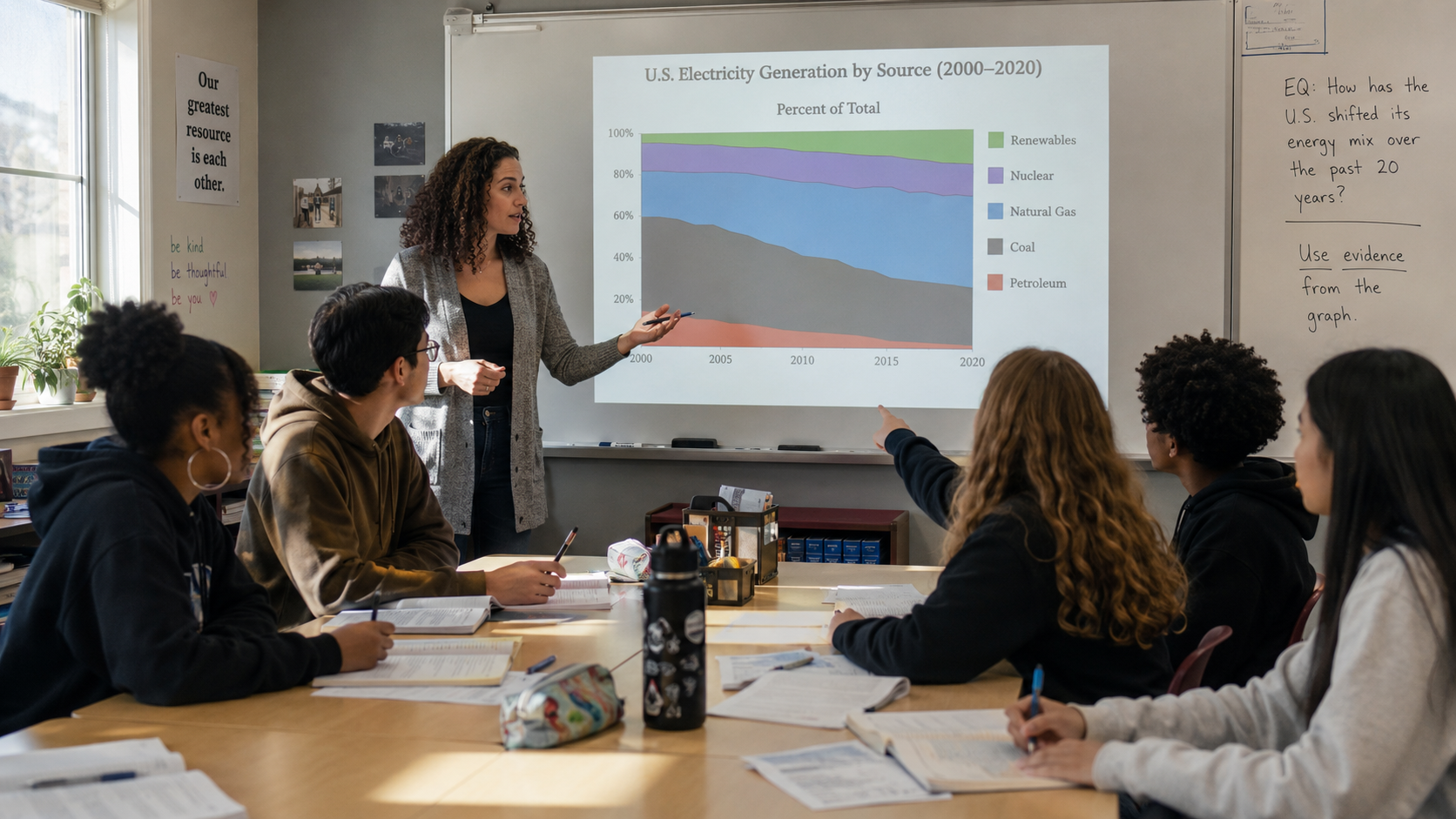
The Teacher Role in Data Literacy
A student can read the tallest bar, name the trend, and still miss the real work of data literacy.
That is the tension teachers face every time a chart enters the classroom. A chart can look simple. It has a title, labels, numbers, colors, and a shape that seems to say something. But the moment students move from noticing what is visible to deciding what it means, they need more than a chart-reading checklist. They need a teacher who can slow the room down and help them handle evidence carefully.
The teacher's role in data literacy is not to deliver tricks for finding the answer faster. It is to mediate reasoning: to help students notice what a chart shows, question what it leaves out, and make claims that fit the evidence.
From Reading Charts To Handling Evidence
Many classroom chart routines begin with useful basics: read the title, inspect the axes, notice the scale, compare the categories. Those moves matter. Students cannot reason well from a chart they have not actually inspected.
But the harder part begins after the first observation. A student might say, "The blue bar is taller, so this group is better." Another might see two rising lines and decide one caused the other. A third might trust a dramatic infographic because it looks professional.
In those moments, the teacher becomes the difference between answer-getting and evidence-handling.
A teacher mediating data literacy asks questions such as:
- What in the chart tells you that?
- What can we say from this chart, and what can we not yet say?
- Who collected the data, and how might that matter?
- What would make this evidence stronger?
- Is this an observation, an inference, or an explanation?
These questions do not replace content instruction. They make content instruction more rigorous because students have to show how their ideas are connected to evidence.
The Teacher As Mediator
A mediator is not simply a helper standing nearby. In data literacy, mediation means making reasoning visible and giving students tools they can gradually use on their own.
That might look like a teacher thinking aloud while reading a chart: "I notice the line rises after March, but I do not know whether March caused the change. I would need more context before making that claim." It might look like pausing a discussion and asking students to separate what the chart shows from what they think might explain it. It might mean choosing an imperfect chart on purpose so students can practice asking better questions.
This role is especially important because charts often feel more authoritative than ordinary text. Their visual precision can make claims seem settled before students have considered the source, sample, scale, or design choices. Tufte's work on graphical integrity is useful here not because it proves a classroom intervention, but because it shows why design choices matter when people interpret quantitative displays.
The teacher's job is to help students treat charts as arguments to inspect, not objects to accept.
What The Evidence Supports
The research base for this work is promising, but it should be stated honestly.
There is strong adjacent support for classroom norms that require students to justify claims with evidence. Driver, Newton, and Osborne argue that scientific argumentation belongs in classrooms because students need practice using evidence, evaluating claims, and participating in reasoned discourse. That work is not specifically about chart literacy, but it strongly supports the idea that students learn evidentiary habits through structured classroom talk.
There is also useful evidence from teacher-questioning research. Oliveira's study of science inquiry discussions found that professional development changed the kinds of questions teachers asked, and that more student-centered questions prompted longer and more articulated student responses. Again, this is not a direct chart-literacy study. It is a relevant nearby source showing that teacher questions can shape the quality of classroom reasoning.
Data literacy scholarship also reminds us that students need to ask where data comes from and how it is represented. Work by D'Ignazio and Bhargava supports a broader critical data literacy stance: data is not neutral simply because it is numerical. Students need opportunities to ask who produced data, whose interests are visible, and whose are missing.
The honest conclusion is this: we should not claim that any single sentence frame or protocol has been proven to transform chart reasoning across all classrooms. But the evidence is strong enough to support a practical, research-informed teaching stance. Students benefit when teachers make evidence, source, uncertainty, and claim strength part of ordinary chart discussion.
Five Moves Teachers Can Use
The mediation role becomes real through small repeatable moves.
1. Think Aloud Before Students Answer
Choose a chart and model your own reasoning before asking students to interpret it.
You might say: "The chart shows a sharp increase, but I want to check the scale. I also want to know whether the last data point is a complete month or a partial month. I can describe the increase, but I am not ready to explain why it happened."
This shows students that careful readers do not rush from pattern to explanation.
2. Separate Observation From Interpretation
Use two columns on the board: What the chart shows and What we think it might mean.
A claim such as "the line rises from April to June" belongs in the first column. A claim such as "the new program caused the rise" belongs in the second unless the chart provides evidence for causation.
This simple split helps students see that interpretations are not wrong, but they carry a different evidence burden.
3. Ask For The Evidence Location
When a student makes a claim, ask them to point to the part of the chart that supports it.
The question "Where do you see that?" is gentle, but it changes the discussion. Students learn that claims must be anchored to visible evidence, not just impressions.
4. Normalize Uncertainty
A strong data literacy classroom makes room for statements such as:
- We cannot tell from this chart.
- This suggests a pattern, but it does not explain the cause.
- I would need the source before trusting this.
- The chart raises a question rather than settles it.
These are not weak answers. They are disciplined answers.
5. Use Imperfect Charts Carefully
Students need practice with charts that are incomplete, selective, or potentially misleading. The point is not to trick them. The point is to make inspection visible.
A truncated axis, unclear source, missing sample size, or overdramatic color choice can become a short discussion about how design shapes interpretation. The teacher's role is to keep the conversation constructive: What does the chart show? What does the design make easy to believe? What should we verify before sharing it?
A Classroom Example
Imagine a middle school class looking at a chart that shows homework completion rising after a new study hall policy. Several students quickly say, "The policy worked."
A mediating teacher does not have to reject the answer. She can slow it down.
"What does the chart show for sure?"
Students identify the rise in completion.
"What are we adding when we say the policy caused it?"
Students notice that they are making an explanation, not just an observation.
"What else would we need to know?"
Now the discussion opens. Was attendance different? Were assignments shorter? Did grading policy change? Was the time period long enough? Did every grade level follow the same policy?
The chart still matters. But now it is part of an inquiry rather than the end of one.
Why This Role Matters
Students are growing up in a world where charts appear in news feeds, product claims, school reports, public health messages, and political arguments. Some charts are careful. Some are careless. Some are designed to persuade before the reader has time to inspect.
If students learn only to decode chart features, they remain vulnerable to confident but unsupported interpretations. If they learn to handle evidence, they become more careful readers, writers, and citizens.
That work requires teachers. Not because teachers must know every statistical method, but because teachers can create the habits of mind that come before responsible analysis: slowing down, asking what is visible, naming uncertainty, checking sources, and matching claims to evidence.
The teacher role in data literacy is therefore both practical and ethical. It helps students do better work in class, and it prepares them to meet public data claims with curiosity rather than reflexive trust.
A good starting point is simple. The next time a student makes a claim from a chart, ask: "What in the chart tells you that?" Then wait. The pause is part of the lesson.