

A student looks at a bar chart.
You ask:
Which product sold best?
The student answers:
This one.
You ask:
Why?
The student says:
Because it has the biggest bar.
Then you ask:
What does that suggest?
Silence.
The student has read the graph.
The student has not yet interpreted what the graph means.
This is one of the most common graph literacy problems teachers see. Students can often find information in a chart. They can identify the largest bar, read a label, copy a number, or notice that one category is higher than another.
But then the harder question arrives:
So what does that mean?
That is where many students stall.
Reading Is Not Interpreting
Graph literacy begins with reading data.
Students need to know what value is shown, which category is larger, what the axis says, and where the information appears.
But graph literacy does not end there.
A student who can read a chart can answer:
What does the chart show?
A student who can interpret a chart can answer:
What does the chart mean?
Those are different skills.
The first is extraction.
The second is reasoning.
Three Levels of Graph Interpretation
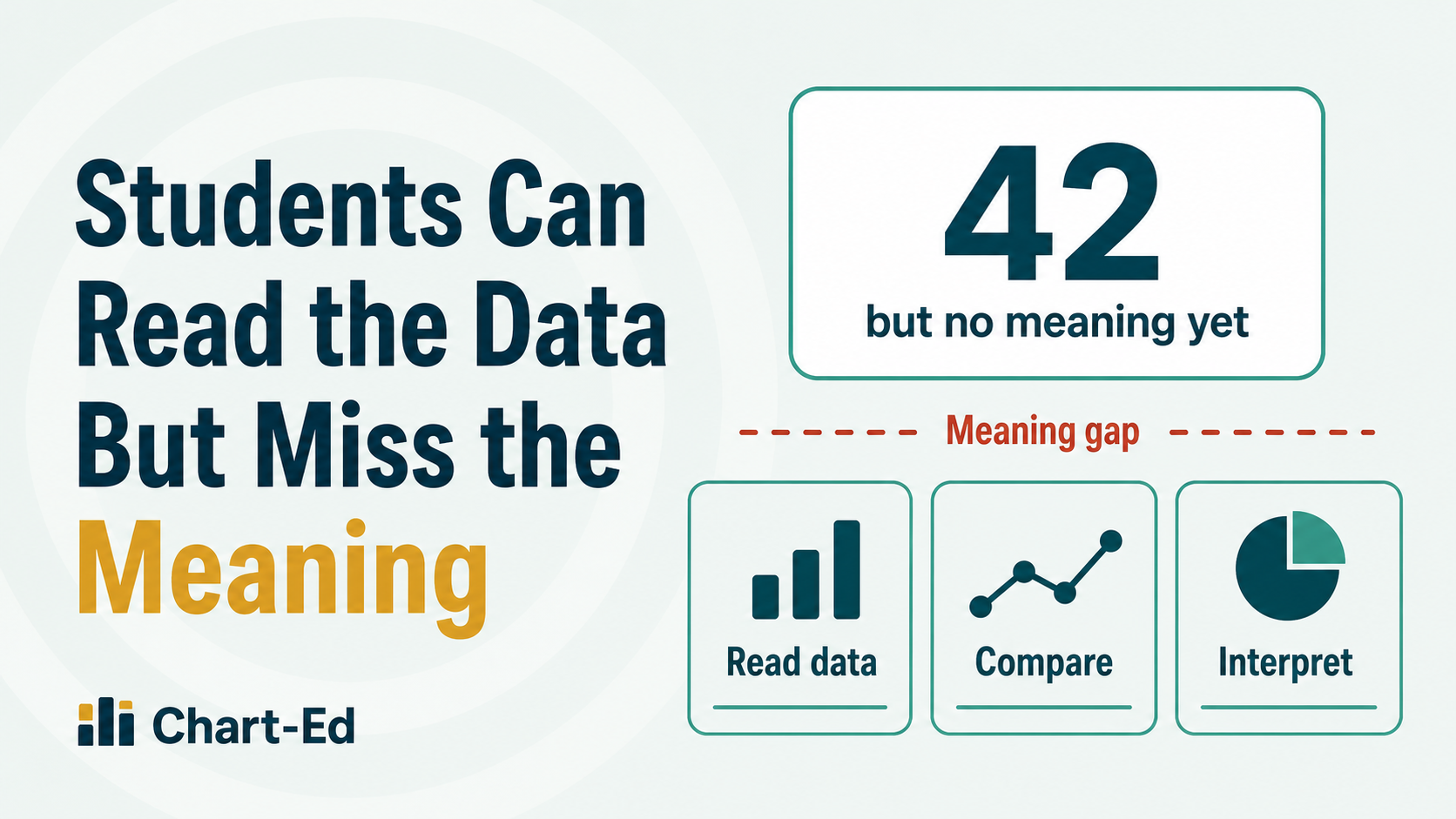
One useful way to think about graph interpretation is through three levels:
Read Data
Read Between Data
Read Beyond Data
At the first level, students locate information.
At the second level, students compare information and notice patterns.
At the third level, students consider what conclusions the evidence may justify.
Many classroom tasks stay at the first level while asking students to perform at the third.
That mismatch matters.
Students may move among these levels repeatedly as they interpret a graph. The levels are a planning tool, not a rigid staircase.
If a student has only practiced finding values, we should not be surprised when they struggle to explain significance, compare patterns, or justify conclusions.
The Classroom Signal
You can often hear the difference in student responses.
Level 1 sounds like:
It says 42.
This one is the biggest.
The line goes up.
Level 2 sounds like:
This category is higher than that one.
The increase is larger after 2020.
The pattern changes in the middle.
Level 3 sounds like:
The chart suggests...
This evidence supports...
One possible explanation is...
The chart does not prove...
The shift from Level 1 to Level 3 is not automatic.
It has to be taught.
The Real Problem
When students read data but miss meaning, the problem is not simply that they need more charts.
They need better questions.
Instead of asking only:
What value is shown?
we also need to ask:
How do the values compare?
What pattern is visible?
What conclusion is justified?
What evidence supports that interpretation?
What does the chart not show?
Those questions move students from data to meaning.
Why This Matters
Students encounter charts in science, social studies, mathematics, ELA informational text, assessments, news, and everyday life.
If they only learn to extract values, they remain vulnerable to shallow interpretation.
They may copy a number without understanding it.
They may notice a trend without explaining its significance.
They may make a claim without checking whether the chart actually supports it.
The goal is not for students to sound more sophisticated.
The goal is for students to reason more responsibly from evidence.
A Practical Classroom Move
The next time students work with a chart, sort your questions into three levels:
Read Data
Read Between Data
Read Beyond Data
Then ask:
At which level are my students currently operating?
This one question can change the lesson.
If students are still locating values, they may not be ready for broad conclusions.
If students can compare categories, they may be ready to explain patterns.
If students can identify patterns, they may be ready to justify interpretations.
That is the progression.
The strongest graph literacy instruction also asks students to separate three questions:
What does the chart show?
What does the chart not show?
What conclusions are justified?
That is where reading becomes interpretation, and interpretation becomes judgment.
Free Resource
Use the Levels of Graph Interpretation Guide to plan chart questions across all three levels.
Download the free Levels of Graph Interpretation Guide
Product Bridge
Looking for structured practice that helps students move from reading data to interpreting meaning?
Bibliography
- Aoyama, K. (2007). "Investigating a Hierarchy of Students' Interpretations of Graphs." International Electronic Journal of Mathematics Education, 2(3), 298-318. https://doi.org/10.29333/iejme/214
- Curcio, F. R. (1987). "Comprehension of Mathematical Relationships Expressed in Graphs." Journal for Research in Mathematics Education, 18(5), 382-393. https://doi.org/10.5951/jresematheduc.18.5.0382
- Friel, S. N., Curcio, F. R., and Bright, G. W. (2001). "Making Sense of Graphs: Critical Factors Influencing Comprehension and Instructional Implications." Journal for Research in Mathematics Education, 32(2), 124-158. https://doi.org/10.2307/749671
- Garfield, J. B., and Ben-Zvi, D. (2008). Developing Students' Statistical Reasoning: Connecting Research and Teaching Practice. Springer. https://doi.org/10.1007/978-1-4020-8383-9
- Shah, P., and Hoeffner, J. (2002). "Review of Graph Comprehension Research: Implications for Instruction." Educational Psychology Review, 14(1), 47-69. https://doi.org/10.1023/A:1013180410169