

Teacher Pain
Students often read the bars, lines, labels, and colors before asking whether the chart deserves their trust.
The chart may look clean. The title may sound confident. The pattern may be easy to see.
But students still need to ask:
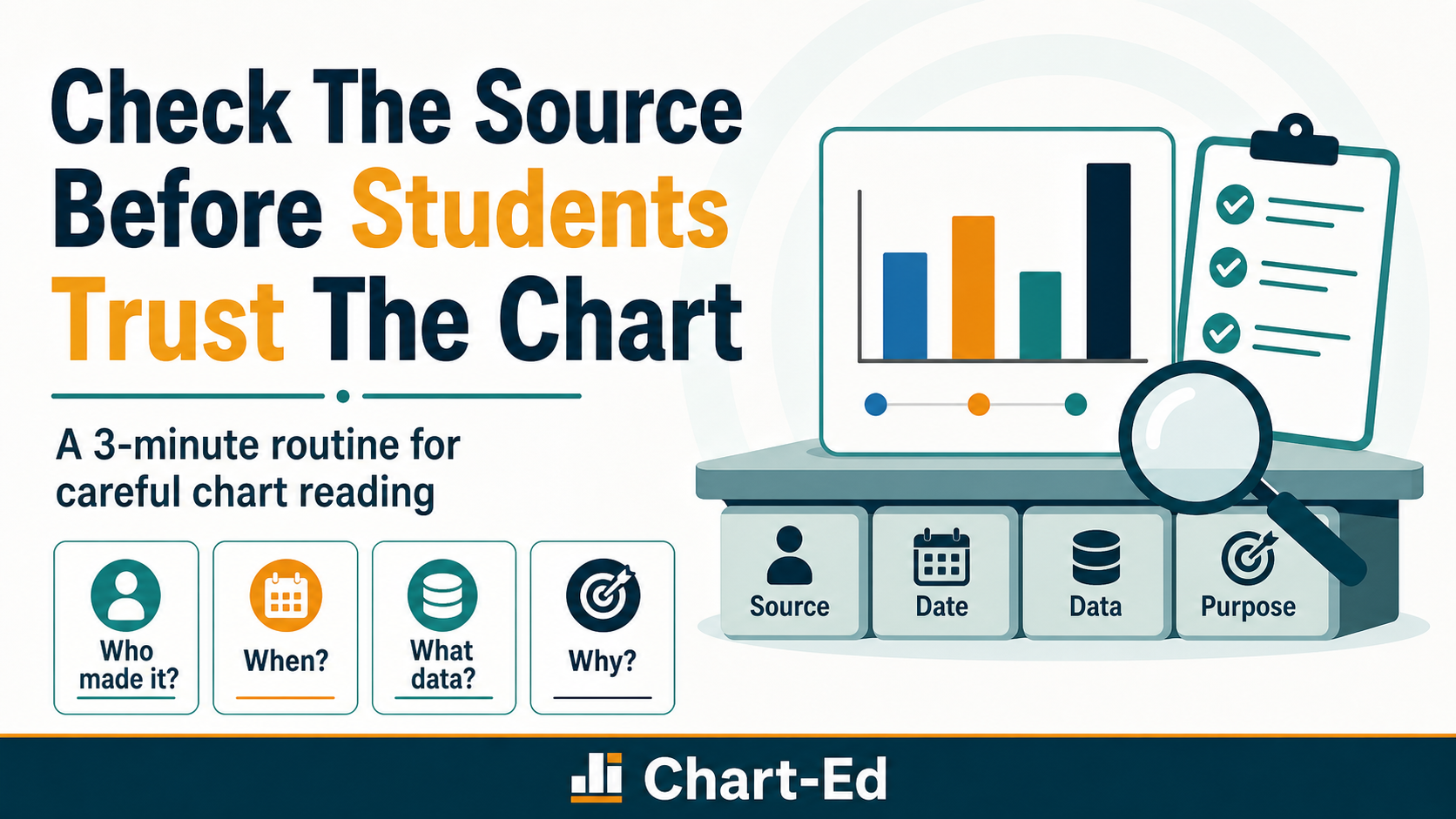
Who made this?
When was it made?
What data does it use?
Why might it have been made?
What Is Really Happening
Students are treating the chart as a finished answer instead of a piece of evidence.
The reasoning problem is this:
Judgment begins before source inspection.
Chart-Ed treats this as a trust-before-interpretation problem. Students do not need to distrust every chart. They need a fast habit for checking source, time, data, and purpose before building claims.
Classroom Move
Before students explain what a chart means, give them three minutes to answer four questions:
Who made it?
When was it made?
What data does it use?
Why might it have been made?
That is enough to change the room.
Students are no longer treating the chart as self-explanatory. They are inspecting the evidence before using it.
The 3-Minute Routine
1. Who Made It?
Ask students to identify the person, organization, publication, class, agency, or company responsible for the chart.
If the maker is missing, students should notice that too.
2. When Was It Made?
Ask whether the chart is current enough for the question being discussed.
A chart from ten years ago may be useful for a history question. It may be weak evidence for a claim about what is happening now.
3. What Data Does It Use?
Ask students to look for the dataset, sample, categories, units, or time period.
If those details are missing, students can still describe the chart, but they should name what remains unclear.
4. Why Might It Have Been Made?
Ask students to consider purpose.
Was the chart made to inform, persuade, advertise, summarize, compare, warn, or provoke?
Purpose does not automatically make a chart wrong. It helps students read with care.
Example
Imagine students are looking at a chart titled:
Screen Time Is Rising
A student says:
Kids are addicted to phones.
Before debating that claim, pause for the source check.
The class notices:
The chart was created by a technology advocacy group.
It is three years old.
It uses a survey of families from one region.
It may have been made to raise concern about digital habits.
Now the claim becomes more careful:
The chart suggests screen time rose in this survey group, but it does not prove that all students are addicted to phones.
That is stronger reasoning because it respects both the evidence and its limits.
How To Use The Free Resource
Use the 3-Minute Chart Source Check whenever students encounter a chart in an article, textbook, worksheet, assessment item, investigation, source, or class discussion.
Keep it fast. This should not become a full research project every time. The goal is to build a reflex:
Check the source before explaining the story.
Common Mistake To Watch For
Do not turn source checking into cynicism.
The lesson is not:
Charts cannot be trusted.
The lesson is:
Charts should be inspected before they are used as evidence.
That distinction matters.
Free Resource
Download the 3-Minute Chart Source Check
Product Bridge
If you want students to practice source checking, evidence limits, and careful chart claims with structured examples, use Chart-Ed Data Forensics.